Key Takeaways
- Common errors include mixed files (someone else's info), wrong balances, and duplicate collection accounts.
- You must pull all three of your free credit reports and compare them side-by-side to effectively spot discrepancies.
- Document any errors you find carefully, as accuracy directly impacts your credit score and financial credibility.
- Errors can lead to higher interest rates, loan denials, and even identity theft if left unaddressed.
- While an important first step, remember that building strong credit also requires consistently good financial habits and your own accounts.
The Silent Saboteurs: Unmasking Credit Report Errors
These inaccuracies, known as credit report errors, are far more common than you might think. They're like uninvited guests in your financial home, silently chipping away at the foundation you've worked so hard to build. Left unaddressed, these 'unwanted debris' can weaken your credit score, making it harder to secure loans, rent an apartment, or even get a new job. Understanding the types of errors that frequently appear and knowing how to spot them is a vital skill for anyone committed to safeguarding their financial future.
The most common credit report errors include mixed files (where your information is blended with someone else's), incorrect account balances or statuses, duplicate collection accounts, outdated negative information, and fraudulent accounts opened in your name.
A practical way to start is by prioritizing error categories based on likely impact.
This gives you a cleaner review order so you catch the most damaging issues first.
Why Your Credit Report is Your Nest's Blueprint (and Why Errors Matter)
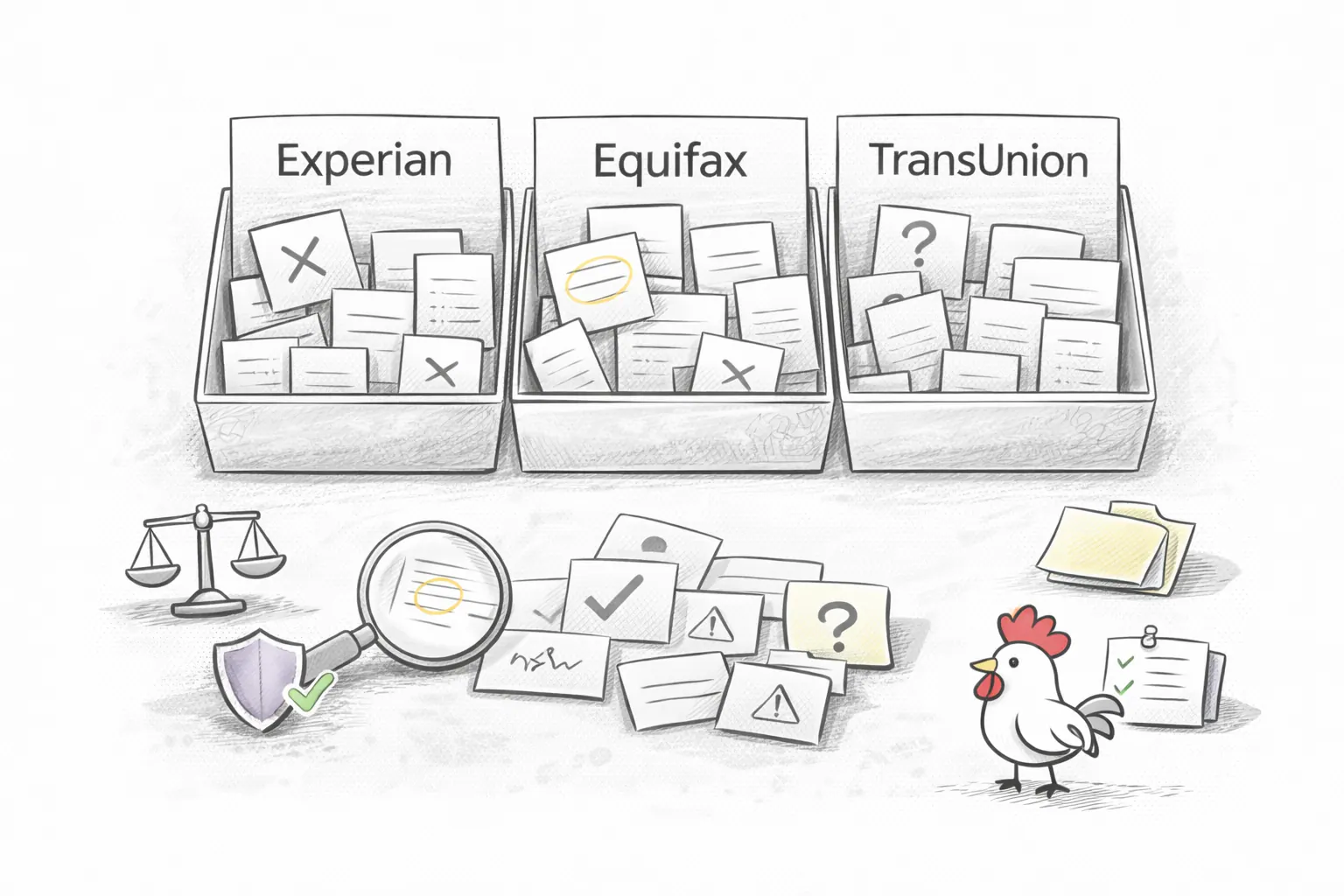
To even begin this critical examination, you first need to get your hands on these blueprints. Remember, you're entitled to a free copy of your credit report from each of the three major bureaus annually. We cover the retrieval process in detail in our free reports guide, and it remains your first crucial step in this process. Make it a habit to pull and review these reports regularly; it’s one of the best ways to keep your financial nest protected.
The Sneaky Twigs: Most Common Credit Report Errors to Watch For
Now that you know why accuracy is paramount, let's look at the specific types of 'unwanted debris' that often find their way into credit reports:
-
Mixed Files: This is perhaps one of the most frustrating and impactful errors. A mixed file occurs when your credit information gets combined with someone else's, often due to similar names, addresses, or Social Security numbers.
- Mini-Story: Meet Nico. Nico is a newcomer, just starting to build their credit nest. They applied for their first apartment, excited for the independence. The landlord, however, pulls a credit report showing a slew of late payments and collection accounts Nico has never seen before, belonging to someone with a similar name and an address two states away. Nico's file got mixed with a 'ghost' profile, making their thin file look terrible. Without knowing how to spot and dispute this, Nico's housing application could easily be denied, simply because of someone else's financial history.
-
Incorrect Account Balances or Statuses: These errors can range from minor annoyances to significant score dampeners. You might see an account reported as having an outstanding balance when you've already paid it off, or a credit card account listed as open when you closed it years ago. Sometimes, a loan might show a higher original balance than what it actually was, or a payment could be reported as late when it was, in fact, on time.
-
Duplicate Collection Accounts: It's bad enough to have one collection account reported, but sometimes the same debt can appear multiple times, either by the original creditor and then a collection agency, or by different collection agencies. Each duplicate entry can mistakenly look like a separate negative mark, exaggerating the severity of your financial history.
-
Fraudulent Accounts / Identity Theft: This is a grave concern. If you see accounts on your report that you never opened or authorized, it's a strong indicator of identity theft. These could be credit cards, loans, or even utility accounts. Spotting these quickly is paramount to prevent further damage.
-
Outdated Negative Information: Most negative information (like late payments, collections, or charge-offs) can only remain on your report for about seven years. Bankruptcies typically stay for 7-10 years. If you find old negative items still lingering past their legal reporting period, they're errors that need to be removed.
-
Incorrect Personal Information: While seemingly benign, errors in your name (misspellings), address (old or incorrect addresses), phone numbers, or employer information can still cause issues. Lenders might question the accuracy of your file, and in some cases, these inaccuracies can contribute to mixed files.
-
Inaccurate Payment History: This error directly impacts the most significant factor in your credit score: payment history. If a payment you made on time is reported as 30, 60, or 90 days late, it can severely damage your score. Conversely, if a payment you did miss is removed because it was reported in error, that correction may help your score recover.
Use this quick scanner to catch high-risk error patterns faster:
Mixed File Clues
Name, address, or employer details that clearly belong to someone else.
Balance/Status Drift
Paid or closed accounts that still show high balances or late marks.
Duplicate Entries
The same debt reported twice by multiple furnishers or collectors.
Fraud Signals
Unknown accounts, utility lines, or lender activity you never authorized.
Once these patterns are clear, your full report audit becomes much more efficient.
Your Detective Toolkit: How to Spot These Errors
Spotting these errors requires a methodical approach, much like a meticulous bird inspecting every fiber of its nest. Here’s how you can become your own credit report detective:
-
Pull All Three Reports, Annually: This cannot be stressed enough. Each bureau (Equifax, Experian, TransUnion) might have slightly different information, or even completely different errors. One bureau could have a clean record for you, while another holds a significant error. Access your free reports at AnnualCreditReport.com. It is the only federally authorized source. If you need the retrieval process, follow Your Financial Health Check-up: How to Get Your 3 Free Credit Reports.
-
Compare Them Side-by-Side: Once you have all three, don't just glance at them individually. Lay them out and compare every single entry. Look for discrepancies in:
- Personal Information: Are your name, address, date of birth, and employer details correct and consistent across all three?
- Accounts (Tradelines): Do all accounts listed belong to you? Are the account numbers correct? Are the opening dates, credit limits, and current balances accurate? Is the payment history (on-time vs. late) correct for each account?
- Inquiries: Are there any hard inquiries from lenders you don't recognize or didn't authorize? If you need a timing and impact primer, review the hard inquiry dilemma guide.
- Public Records: Are there any bankruptcies, liens, or judgments that are inaccurate or outdated?
If you are auditing quickly, this table keeps your checks in a high-impact order:
Error Verification Order
| Check Area | Why It Matters | Escalate If... |
|---|---|---|
| Identity details | Prevents mixed files and identity confusion | You find addresses or employers that are not yours |
| Account ownership | Flags fraud and unauthorized borrowing | Any account appears that you never opened |
| Balances/payment status | Directly affects score and lender risk view | Paid accounts show late marks or wrong balances |
| Collections/public records | Major underwriting and approval impact | Dates are stale or duplicate entries appear |
-
Cross-Reference with Your Records: Compare the information on your credit reports with your own financial statements, loan documents, and payment records. This helps you verify balances, payment dates, and account statuses. For a comprehensive understanding of each section, consult A Step-by-Step Guide to Reading and Understanding Your Credit Report to know exactly what you're looking at.
-
Look for the 'Red Flags':
-
Accounts you don't recognize: This is the most obvious sign of potential fraud or mixed files.
-
Incorrect payment statuses: A reported late payment when you know you paid on time.
-
Accounts opened on dates you don't recall: Especially if you don't recognize the creditor.
-
Unusual credit limits or balances: If your credit card suddenly shows a balance much higher than you've ever carried, or a limit lower than you know it to be.
-
Different versions of the same account: The same loan or credit card reported by different creditors or collection agencies, or different opening dates or statuses for what should be the same account.
-
Mini-Story: Rebuilder Riley. Riley is working hard to rebuild their nest after a challenging few years. They diligently pay all their current bills on time and are seeing slow but steady progress. However, when Riley pulls their reports, they notice an old medical collection from five years ago is suddenly appearing on their report for the second time from a different collection agency, making it look like a new, separate negative item. This duplicate entry is unfairly dragging down their score, despite their recent good behavior. Riley quickly identifies this as an error that needs to be disputed.
-
The Impact of an Untidy Nest: Why Accuracy Protects Your Score and Credibility
Every piece of information on your credit report contributes to your overall financial standing and, ultimately, your credit score. An error, no matter how small it seems, can have a ripple effect across your entire financial nest.
-
Lower Credit Scores: Incorrect late payments, inflated balances (leading to higher utilization), or duplicate negative accounts can directly reduce your credit score. A lower score means you appear riskier to lenders.
-
Higher Borrowing Costs: With a lower score, you'll likely be offered higher interest rates on mortgages, car loans, and credit cards. Over the lifetime of a loan, this can cost you thousands of extra dollars. Imagine trying to upgrade your nest with an expensive new branch, only to find the cost significantly inflated due to a clerical error on your report!
-
Loan and Credit Card Denials: Serious errors can lead to outright denial when you apply for new credit, even if you’re otherwise financially responsible.
-
Impact on Other Areas: Beyond loans, a poor credit report due to errors can affect your ability to rent an apartment, get approved for utilities without a hefty deposit, or even secure certain types of insurance at favorable rates.
This comparison shows why correction speed matters:
The gap between these two paths often comes down to how quickly you document and dispute.
- Mini-Story: Time-Sensitive Tina. Tina needed to quickly secure a small personal loan for an unexpected home repair when a 'storm' hit her nest. She had a good credit history, but when the lender pulled her report, it showed a credit card account with a $2,000 balance that she had closed and paid off completely six months prior. This inflated balance made her debt-to-income ratio look higher than it was, and her credit utilization ratio also spiked. The lender hesitated, and the delay in approving the loan meant Tina missed out on a crucial repair window, causing more damage. If she had spotted and corrected that error earlier, her loan approval would have been swift and smooth.
Your Next Branch: What to Do When You Find an Error
When you spot a questionable item, use this decision checkpoint first:
Do you have documentation showing the item is inaccurate?
This prevents weak filings and improves your chances of a fast correction.
- Gather Evidence: Collect any documents that support your claim (e.g., bank statements, canceled checks, letters from creditors showing accounts paid in full). The more proof you have, the stronger your case.
- Contact the Bureau and the Furnisher: You can dispute directly with the credit bureau online, by mail, or by phone. It's often recommended to send disputes by certified mail, return receipt requested, so you have proof it was sent and received. You should also contact the company that reported the information (the 'furnisher,' like your bank or a collection agency) directly.
- Be Patient and Persistent: The bureaus generally have 30 days to investigate your dispute. If they find an error, they must correct it. If not, they must explain why.
Use this sequence to keep your dispute process organized from day one:
Capture the discrepancy
Save report screenshots and account context immediately.
Assemble evidence
Collect statements, payment proofs, and relevant correspondence.
Dispute bureau + furnisher
Submit matching claims to both parties with the same evidence set.
Track investigation windows
Follow deadlines and confirm each correction posts to your reports.
Building a Resilient Roost: Proactive Steps & Call to Action
Spotting and correcting errors is a critical defensive measure for your credit nest, but true strength comes from proactive building. By consistently monitoring your reports and maintaining good financial habits, you create a robust and resilient foundation. Consider these proactive steps:
- Stagger Your Free Reports: Instead of pulling all three at once, consider pulling one report every four months (e.g., Experian in January, Equifax in May, TransUnion in September). This way, you have continuous monitoring throughout the year.
- Regularly Review Statements: Keep an eye on your monthly credit card and loan statements for any suspicious activity or incorrect balances.
- Sign Up for Credit Monitoring: Many services (some free, some paid) can alert you to significant changes or new accounts on your credit report, helping you catch fraud or errors early.
Keep your monitoring habits practical with this simple do-vs-avoid framework:
- Audit all three bureaus on a repeating schedule.
- Save documentation for each discrepancy before disputing.
- Follow up until corrections are reflected across reports.
- Assume one clean report means all three are clean.
- Submit disputes with no supporting evidence attached.
- Stop monitoring after one correction is made.
While vigilant error checking is crucial, remember that building a robust credit nest also involves actively adding strong branches and healthy habits. For newcomers or rebuilders, authorized user (AU) tradelines may serve as one possible path to earlier credit visibility by associating your file with a seasoned account. Outcomes often depend on lender policy, scoring model, and your current profile. This approach should be paired with durable, long-term builders. Consider opening your own secured credit card, exploring credit-builder loans, or signing up for rent reporting to add your own, independently managed accounts to your nest.
Disclosure
ImportantSome lenders and credit scoring models may filter out, discount, or weigh authorized user tradelines differently in their underwriting decisions. Results vary based on lender policies, the specific scoring model used, and your unique credit profile. An AU tradeline does not guarantee loan approval or any specific credit score outcome.
Pair correction work with ongoing credit-building actions so each reporting cycle moves in your favor.
Action Items for a Cleaner Credit Report
- Stagger your free credit reports for continuous monitoring.
- Compare all three bureaus side-by-side instead of reviewing one report in isolation.
- Document every discrepancy before filing disputes with bureau and furnisher.
- Track investigation deadlines and verify that each correction posts accurately.
- Add long-term builders such as secured cards, credit-builder loans, and rent reporting.
Ready to fortify your credit nest and ensure its blueprint is accurate? Start by claiming your free credit reports today, then explore options like authorized user tradelines as one possible path to credit visibility and secured cards, credit-builder loans, or rent reporting for long-term growth.
Frequently Asked Questions
-
What are the most common credit report errors I should look for?
- The most common credit report errors include mixed files (where your information is blended with someone else's), incorrect account balances or statuses, duplicate collection accounts, outdated negative information, and fraudulent accounts opened in your name.
-
How often should I check my credit reports?
- You are entitled to a free report from each of the three major bureaus (Equifax, Experian, TransUnion) annually. It's highly recommended to pull all three, or stagger them throughout the year (e.g., one every four months) for continuous monitoring.
-
Why do credit report errors matter so much for my financial health?
- Errors can lower your credit score, leading to higher interest rates on loans, outright loan denials, and difficulties with renting apartments or securing favorable insurance rates. They can misrepresent your financial reliability.
-
Where is the best place to get my free credit reports?
- The only federally authorized website to get your free credit reports is AnnualCreditReport.com.
-
What should be my first step if I discover an error on my credit report?
- Your first step should be to gather all supporting evidence (like bank statements or payment confirmations) and then dispute the error directly with both the credit bureau and the company that reported the information (the furnisher).
-
How long do negative items, like late payments or collections, typically stay on my credit report?
- Most negative information, such as late payments, collections, or charge-offs, can remain on your credit report for about seven years. Bankruptcies can stay for 7-10 years.
Your credit report is more than just a document; it's a reflection of your financial journey and a key to future opportunities. Don't let inaccurate information hold you back. By becoming a diligent guardian of your credit nest, inspecting it regularly for any unwanted twigs or loose threads, and promptly addressing any errors you find, you empower yourself to build the strong, secure financial future you deserve. Keep your blueprint clean, and your nest will thrive.