Key Takeaways
- Bankruptcy is a legal debt-relief process, usually considered after other options fail.
- Chapter 7 and Chapter 13 differ in repayment structure, timeline, and asset treatment.
- Filing triggers legal protections like automatic stay, but also leaves long-term credit impact.
- Pre-filing credit counseling is required and should include alternatives review.
- Post-bankruptcy recovery depends on disciplined budgeting, emergency savings, and positive credit-building habits.
The Fork in the Path: Chapter 7 vs. Chapter 13
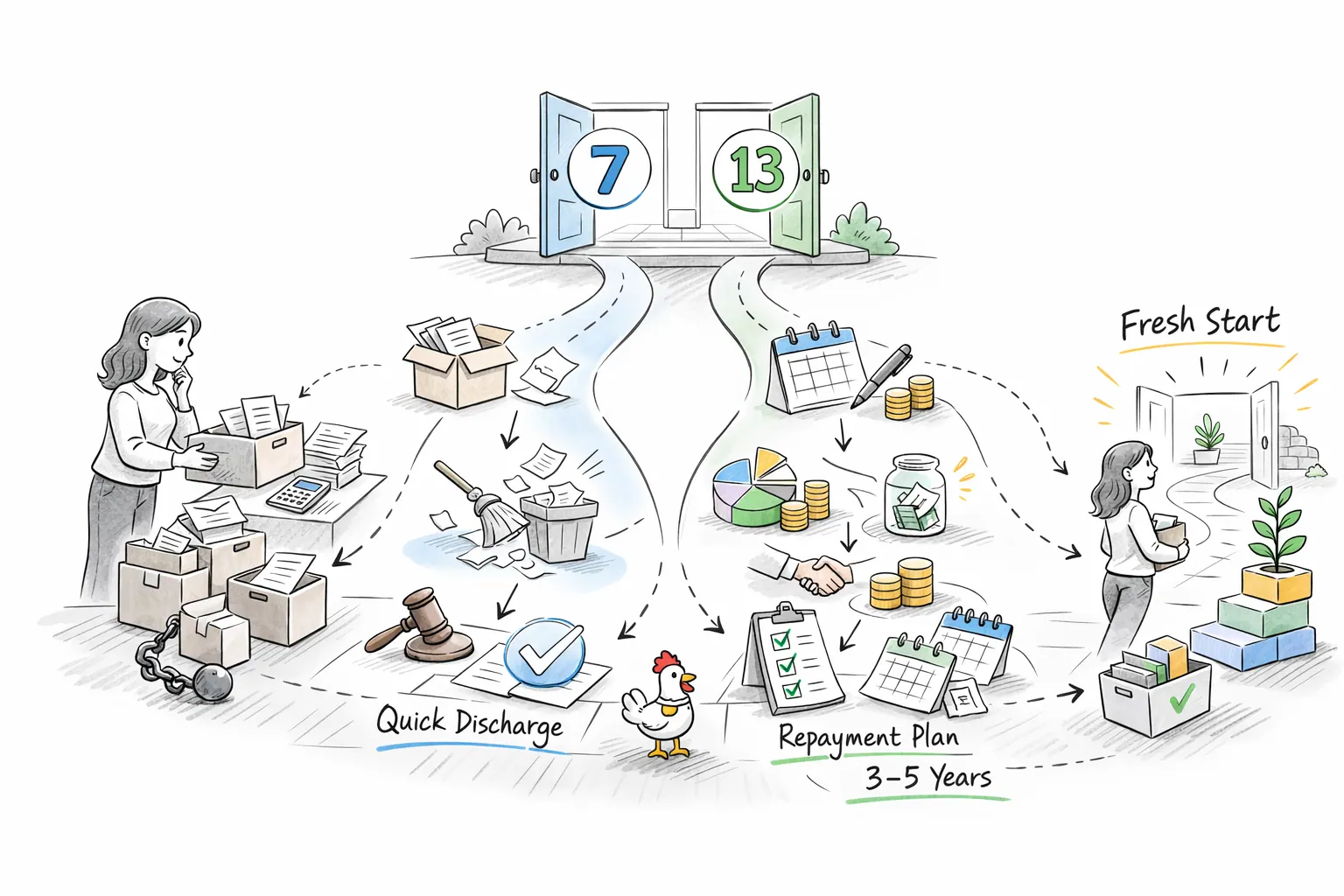
When you explore bankruptcy, you'll primarily encounter two main paths for individuals: Chapter 7 and Chapter 13. Each offers a distinct approach to debt relief, tailored to different financial situations and objectives.
Chapter 7: The Liquidation Path
Chapter 7, often referred to as “liquidation bankruptcy,” is typically the faster and more straightforward option. Its primary purpose is to discharge most of your unsecured debts, such as credit card balances, medical bills, and personal loans.
How it Works:
- The Means Test: To qualify for Chapter 7, you must pass a "means test." This test compares your income to the median income in your state. If your income falls below the median, you likely qualify. If it's above, a more complex calculation determines if you have enough disposable income to pay back some of your debts. If you do, you might be directed toward Chapter 13 instead.
- Asset Assessment: Once you file, a court-appointed trustee takes control of your non-exempt assets. The trustee’s job is to sell these assets and distribute the proceeds to your creditors. However, most Chapter 7 filers find that all their property is exempt under state and federal laws. Common exemptions include necessary household goods, tools of the trade, a portion of home equity, and retirement accounts.
- Debt Discharge: The entire process typically lasts about 3 to 6 months. At the end, most of your unsecured debts are legally discharged, meaning you are no longer obligated to pay them. Certain debts, like most student loans (though there are exceptions), recent tax debts, child support, and alimony, are generally not dischargeable in Chapter 7.
Considerations: Chapter 7 is ideal for individuals with limited income, few assets beyond exemptions, and a significant amount of unsecured debt they cannot reasonably repay. While it offers a quick fresh start, it stays on your credit report for 10 years from the filing date.
Chapter 13: The Reorganization Path
Chapter 13, known as “reorganization bankruptcy,” is designed for individuals with regular income who want to keep their property but need time to repay their debts. Instead of liquidating assets, you propose a repayment plan to the court.
How it Works:
- Repayment Plan: You (with your attorney) will create a detailed plan to repay some or all of your debts over a period of three to five years. This plan is based on your disposable income, which is what's left after essential living expenses. Secured debts (like your mortgage or car loan) can often be "crammed down," meaning you might pay less than the original loan amount if the asset is worth less than the debt, or you might pay them back over a longer term.
- Court Approval: The court must approve your plan, ensuring it's feasible and fair to your creditors. Once approved, you make regular payments to a Chapter 13 trustee, who then distributes the funds to your creditors.
- Debt Discharge: After successfully completing all payments under your plan, any remaining dischargeable unsecured debts are discharged. This process can last 36 to 60 months.
Considerations: Chapter 13 is suitable for individuals with a steady income who have fallen behind on secured debts (like a mortgage or car payment) and want to catch up and keep their property. It also allows you to discharge some debts that are not dischargeable under Chapter 7. Chapter 13 remains on your credit report for 7 years from the filing date.
Chapter Selection Snapshot
| Factor | Chapter 7 | Chapter 13 |
|---|---|---|
| Typical duration | About 3-6 months | About 36-60 months |
| Primary structure | Discharge after liquidation framework | Court-supervised repayment plan |
| Income requirement | Means-test based eligibility | Regular income needed for plan |
| Credit report timeline | Up to 10 years from filing | Up to 7 years from filing |
The Serious Step: Legal and Credit Implications
Filing for bankruptcy is not merely a financial transaction; it's a legal proceeding with profound implications that extend beyond your immediate debt relief. It’s a decision that echoes through your financial life for years, impacting your ability to borrow, secure housing, and even employment in some cases.
Impact on Your Credit Score and Report
- Difficulty Obtaining New Credit: Lenders view bankruptcy as a high risk. Immediately after filing, getting approved for new credit cards, loans, or mortgages will be challenging. When you do, the interest rates will likely be very high.
- Public Record: Bankruptcy is a matter of public record, meaning anyone can access information about your filing.
- Future Borrowing: While difficult initially, it’s not impossible to rebuild. Over time, as the bankruptcy ages on your report and you establish new, positive credit, its impact will lessen. Many people successfully obtain mortgages and other loans years after discharge.
Legal Ramifications and Protections
The legal aspect of bankruptcy is complex, which is why working with a qualified attorney is crucial. (Remember, this article is for educational purposes only and not legal advice!)
- Automatic Stay: Upon filing, an "automatic stay" immediately goes into effect. This powerful legal injunction stops most collection activities, including lawsuits, wage garnishments, repossessions, and foreclosures. It provides immediate relief from creditor harassment.
- Mandatory Credit Counseling: Before you can file for bankruptcy, federal law requires you to undergo credit counseling from an approved agency within 180 days prior to filing. This counseling is designed to explore alternatives to bankruptcy, like a Debt Management Plan (DMP), and help you understand the consequences. This is an essential step, and agencies like those offering non-profit credit counseling can provide invaluable, unbiased guidance.
- Financial Management Course: After filing, you'll also need to complete a debtor education course on personal financial management to receive your debt discharge.
It is crucial to approach this deeply impactful process with the right mindset and clear documentation from the start:
Bankruptcy Guardrails
- Use qualified legal counsel for filing decisions and court process
- Complete required pre-filing counseling from approved providers
- Keep all filing, trustee, and court records organized from day one
- Assume all debt types are automatically dischargeable
- Delay legal review when lawsuits, foreclosure, or garnishment risk is active
- Treat bankruptcy as a credit-repair tactic instead of a legal remedy
Additionally, please keep in mind the following disclaimer regarding the information provided here:
Legal Disclosure
ImportantThis article is educational and not legal advice. Bankruptcy outcomes depend on jurisdiction, debt mix, exemptions, and court-approved case facts.
Before You File: Exploring Alternatives
- Non-Profit Credit Counseling: As mentioned, this is often a prerequisite for bankruptcy, but it's also a powerful tool in its own right. A certified credit counselor can help you assess your entire financial situation, create a budget, and negotiate with creditors for lower interest rates or more manageable payment plans. Often, they can help you set up a Debt Management Plan (DMP), which consolidates your unsecured debts into one monthly payment managed by the agency, often with reduced interest rates.
- Debt Consolidation Loans: If you have good enough credit, you might qualify for a debt consolidation loan. This allows you to combine multiple high-interest debts into a single loan with a potentially lower interest rate and one fixed monthly payment. This simplifies repayment and can save you money, but it requires discipline not to accrue new debt.
- Negotiating with Creditors: Sometimes, you can directly negotiate with your creditors for a lower settlement amount or an extended payment plan. This is particularly true if your accounts are already in collections. Always get any agreements in writing!
- Avoiding Predatory Loans: In times of crisis, the temptation of quick cash from sources like predatory loans, such as payday or title loans, can be immense. Resist this urge fiercely, as these loans trap borrowers in cycles of ever-increasing debt, often making an already dire situation catastrophic.
Pre-Filing Review Checklist
- Confirm full debt inventory by type: secured vs unsecured vs priority debt
- Model affordability under non-bankruptcy strategies for at least 60 days
- Complete approved pre-filing credit counseling requirement
- Review legal exposure timeline with licensed counsel before filing
Rebuilding Your Nest: A Plan for the Future
Bankruptcy is not an ending; it’s a difficult beginning. The moment your debts are discharged, your focus must pivot entirely to rebuilding your financial foundation, establishing new habits, and safeguarding your future. This is where the true work begins, laying new, stronger twigs for a more resilient nest.
The Importance of New Habits and an Emergency Fund
Budgeting
Establish a strict and realistic budget to control cash flow and trim out expenses.
Emergency Fund
Build a 3-6 month financial cushion to prevent relapse into high-interest debt.
Financial Literacy
Continuously educate yourself on credit and the dangers of unnecessary debt.
To make sure these habits become long-lasting changes, follow a structured process to keep yourself accountable and steady throughout your recovery.
Stabilize monthly budget and protect essential expenses
Build starter emergency savings to reduce relapse risk
Re-establish positive reporting with low-risk credit builders
Monitor reports monthly and maintain strict payment consistency
Strategically Rebuilding Your Credit
For many newcomers and rebuilders, the fastest credible gateway to establishing visible credit after a bankruptcy discharge is through positive reporting from a responsible financial connection.
- Authorized User (AU) Tradelines: Becoming an authorized user on an established credit card with a long history and excellent payment record can quickly add a positive account to your credit report. This can contribute to building positive credit history, offering a fast gateway to credit visibility. While it's a powerful tool, remember that durable strength relies on adding your own accounts. Learn more about how authorized user tradelines work.
- Secured Credit Cards: These cards require a cash deposit, which typically becomes your credit limit. They are easier to obtain after bankruptcy and report payment activity to credit bureaus. By making on-time payments, you demonstrate responsible credit behavior and begin to rebuild your payment history.
- Credit-Builder Loans: Offered by credit unions and community banks, a credit builder loan works in reverse: you make payments into a savings account, and once the loan is paid off, you receive the funds. The regular, on-time payments are reported to credit bureaus, which may help enhance your credit history.
- Rent Reporting: Many services now allow your on-time rent payments to be reported to credit bureaus, turning a regular expense into a powerful credit-building tool.
- Small Personal Loans: Once you've established some basic credit, a small personal loan (which you pay off diligently) can further diversify your credit mix. Be cautious, though, and ensure the payments are affordable.
Each step, from the first on-time payment on a secured card to establishing an emergency fund, rebuilds trust in your financial responsibility. Focus on the long game: consistent, positive actions over time will erase the shadow of bankruptcy and illuminate a path to robust financial health.
Disclosure
ImportantSome lenders and credit scoring models may filter out, discount, or weigh authorized user tradelines differently in their underwriting decisions. Results vary based on lender policies, the specific scoring model used, and your unique credit profile. An AU tradeline does not guarantee loan approval or any specific credit score outcome.
Real-World Recovery Timeline
Understanding the timeline of recovery can help set realistic expectations for the journey ahead.
Legal and counseling prep
Review alternatives, complete required counseling, and prepare documentation.
Court process
Automatic stay begins and case moves through trustee and court steps.
Debt relief event
Eligible debts are discharged per chapter rules and case outcome.
Credit rebuild phase
Execute budget discipline, savings growth, and positive payment history.
Frequently Asked Questions About Bankruptcy
1. Will I lose all my possessions if I file for Chapter 7 bankruptcy?
- Not necessarily. Most Chapter 7 filers do not lose any property. State and federal laws allow you to exempt certain assets, such as a portion of your home equity, a car, household goods, tools of your trade, and retirement accounts. A bankruptcy attorney can help you understand what assets are exempt in your specific situation.
2. Can bankruptcy stop a foreclosure or repossession?
- Yes, an automatic stay goes into effect immediately upon filing bankruptcy. This stops most collection actions, including foreclosures and repossessions. In Chapter 7, it's a temporary halt, while in Chapter 13, it can provide a more permanent solution by allowing you to catch up on missed payments through a repayment plan.
3. How long does bankruptcy stay on my credit report?
- A Chapter 7 bankruptcy typically remains on your credit report for 10 years from the filing date. A Chapter 13 bankruptcy stays on your report for 7 years from the filing date. While it's a long time, the negative impact lessens over the years, especially as you begin to establish new, positive credit history.
4. Do I need an attorney to file for bankruptcy?
- While it is legally possible to file for bankruptcy without an attorney (pro se), it is highly advisable to seek legal counsel. Bankruptcy law is complex, and errors can lead to delays, dismissal of your case, or even loss of assets. An attorney ensures proper filing, identifies all exemptions, and represents you in court.
5. Can bankruptcy eliminate student loan debt?
- Generally, student loans are very difficult to discharge in bankruptcy. You must prove an "undue hardship" to the court, a standard that is challenging to meet. This typically involves demonstrating that you cannot maintain a minimal standard of living, that the hardship will persist for a significant portion of the repayment period, and that you've made good-faith efforts to repay.
Your Path Forward: Building a Stronger Nest
Considering bankruptcy is an intimidating prospect, a testament to the severe financial storms you may have weathered. But understanding what it is and how it works illuminates a path forward, whether that path leads through bankruptcy itself or through one of its alternatives.
Remember, your goal isn't just to clear debt but to emerge stronger, wiser, and more financially resilient. This is the moment to transform past challenges into future strength. By focusing on diligent budgeting, building an emergency fund, and strategically using tools like authorized user tradelines as a fast gateway to credit visibility, coupled with durable builders like secured cards and credit-builder loans, you can construct a nest that is not just secure, but truly robust.
It’s a journey that demands patience and persistence, but with each responsible choice, you are weaving stronger twigs and reinforcing the foundation of your financial future. We're here to help you understand the tools available, guiding you from that first visible branch of credit to a thriving, secure financial roost.
Disclosure
ImportantThis guide is educational and not legal or financial advice. Always use licensed legal counsel for bankruptcy decisions and filing strategy.